

February 23, 2026
With Love, Himalayas: 6 Mountain Dishes for When You’re Missing Winter

CM Content Team
Update on : 25 February, 2026, 12:10 pm
February 23, 2026
CM Content Team
Winter brings a potpourri of sensory delights: the grinning hues of oranges, the warmth of hand-spun sweaters, and the aroma of your favourite soul food. But for most of India, it’s a short-lived celebration. As the last signs of the season retreat from sight, here are six soulful Himalayan dishes from within and around the country to help you hold onto the romance…just a little bit longer!
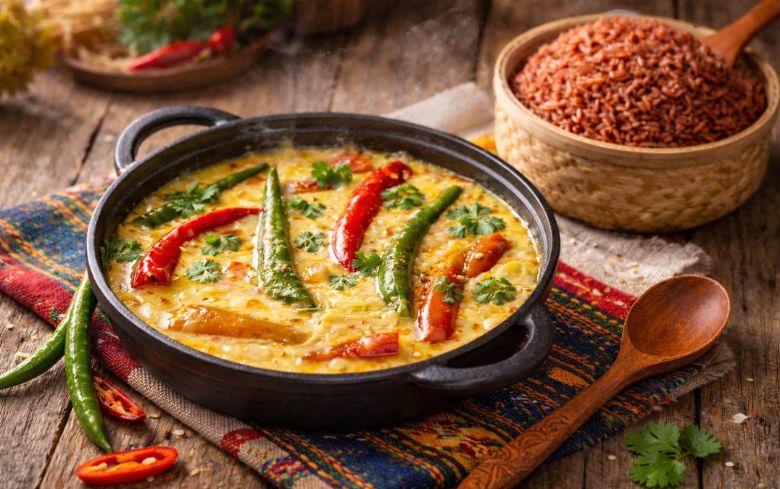 Ema Datshi radiates the fire of local chilies called sha ema—unique in heat and sharpness.
Bhutan’s national dish was born when yak and cow-milk cheese met ample-sized green or red chillies. Don’t go imagining your tame, city version of chilli cheese anything! This cold-clime invention is creamy, spicy, and ideally served piping hot with nutty Bhutanese red rice. Often bulked up as a fuller meal with seasonal vegetables, the rich, silken texture and milk-spice aroma of Ema Datshi has since travelled outside Bhutan’s pristine landscapes and into viral social media fame, with everyone from actor Deepika Padukone to your friendly neighbourhood food influencer raving about its soulfulness. And you don't have to travel to Bhutan to sample the star dish either. You can as easily savour a steaming plateful of Ema Datshi in Mussoorie, Kalimpong, or Naldehra.
Find it at: Club Mahindra Pristine Peaks Naldehra, where you can enjoy the dish with a side of spicy mountain sunsets.
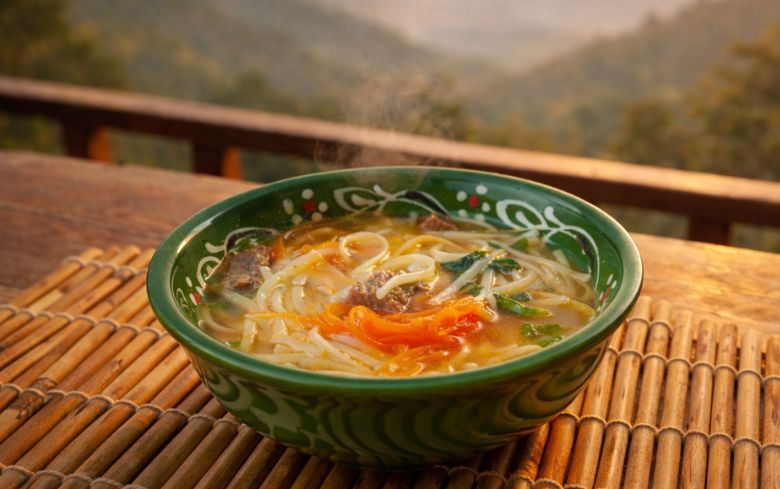 Thukpa is a traditional noodle soup, beloved in the Himalayan culinary tapestry.
In Sikkim’s monasteries and Arunachal Pradesh’s remote villages, dawn breaks to the sound of broth bubbling in wide-mouthed pots. Thukpa, a noodle-soup dish that travelled across mountain passes from Tibet, has long claimed its blended cultural identity as a Himalayan staple. The base simmers for hours: chicken or mutton bones, ginger, garlic, and Sichuan pepper releasing their essence into water that gradually transforms into a fragrant elixir. Hand-pulled wheat or rice noodles slip into bowls alongside tender meat, chopped spring onions, and whatever vegetables the season permits: turnips, radish, and spinach. In Tawang’s markets, roadside stalls serve thukpa to truck drivers and monks alike, its universality speaking to how completely this dish has woven itself into daily Himalayan existence. With variations abound, some prefer the clear thenthuk while others the richer gyathuk with vegetables, but the essence remains: sustenance in a bowl, communal and unpretentious.
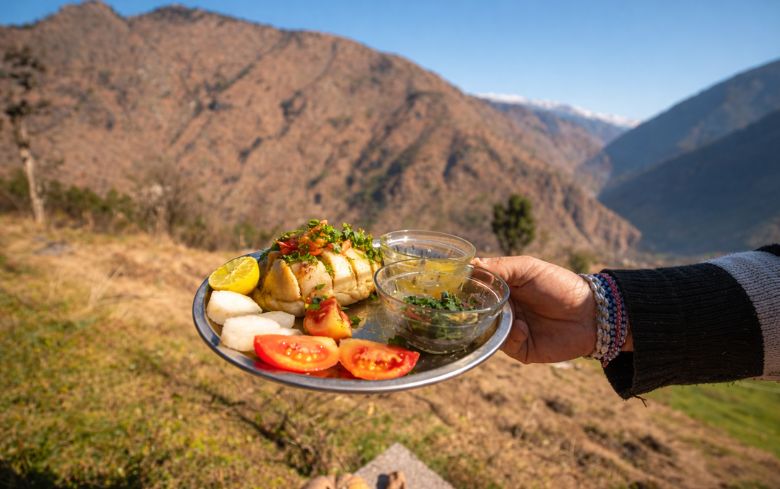 Siddu is a specialty bread from Himachal, best enjoyed with a drizzle of ghee.
In Kullu and Manali’s wooden homes, women knead wheat flour with yeast at night, letting the dough rest through darkness so that by morning, it has risen with the promise of siddu. These steamed bread pockets–plump, slightly sweet, impossibly soft–wrap around a filling of crushed walnuts and poppy seeds, often sweetened with ghee and jaggery. Some families prefer savoury versions with mashed rajma or spiced cottage cheese. Steamed in brass vessels until the exterior develops a gentle sheen, siddu emerges pillowy and warm. You tear it open with your hands—proper mountain etiquette—to reveal the pocket of sweetness or spice within, then dunk the pieces into ghee or chukh (a spicy tomato-based chutney). This is the dish that accompanies shepherds into high meadows and children to their schools. Siddu appears at breakfast tables when nothing else promises complete, carbohydrate-rich comfort against the cold.
Find it at: Club Mahindra White Meadows Manali, where you can relish some warm, pillowy siddu while making plans to visit misty pine valleys.
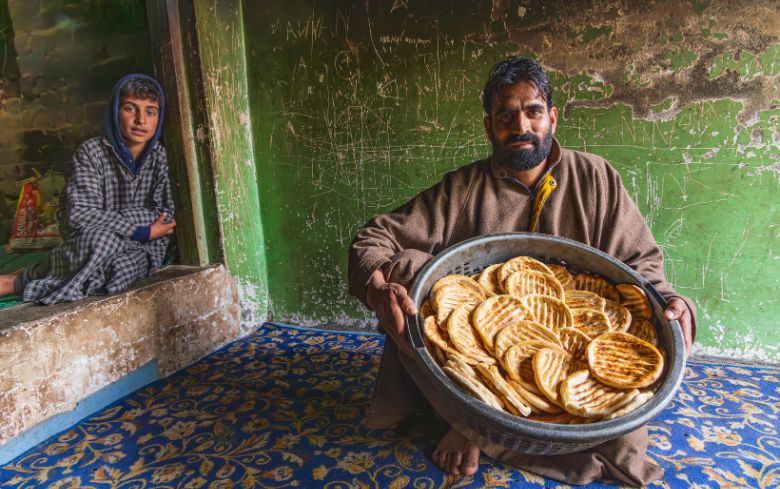 Kashmir's staple bread girda is a worthy accompaniment to the winter delight of harisa.
Long before sunrise paints Srinagar’s frozen Dal Lake, local kitchens begin cooking harisa, a recipe of labour and love steeped in collective memory. Its preparation borders on ceremony. Mutton and wheat are pounded together for hours until meat fibres and grain merge into a single, porridge-like paste. The process, traditionally done in gigantic copper vessels over wood fires, demands constant stirring as cooks add bone marrow, desi ghee, and a precise blend of spices: fennel, cardamom, and cinnamon. By dawn, what began as separate ingredients becomes a thick, golden-hued preparation with a texture between pate and porridge.
During Chillai Kalan (Kashmir’s harshest forty-day winter), harisa appears at breakfast tables across the valley, crowned with a spoonful of ghee and often garnished with fried onions. You eat it with girda or kulcha, scooping the rich, warming paste that seems to radiate heat outward from your belly. Street vendors in downtown Srinagar serve it from huge cauldrons, though the finest harisa, families insist, still comes from home kitchens where recipes pass from one generation to next.
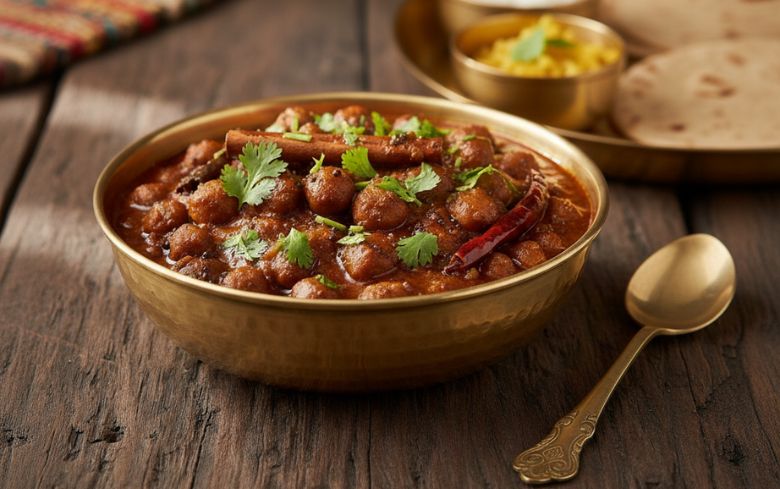 Served in Uttarakhand's traditional metalware, khatte chane packs a tart punch.
The Garhwali and Kumaoni hills offer a palate-cleansing foil to winter’s rich meat preparations through khatte chane–black chickpeas cooked in a sharply tangy gravy that wakes up taste buds dulled by heavy feasting. The chickpeas soak overnight, then simmer until tender before meeting their acidic destiny: a gravy built from crushed tomatoes, roasted coriander, and the crucial ingredient, anardana (dried pomegranate seeds) ground with jambu (a rare Himalayan herb used in pahadi cooking). The resulting curry balances sour, spicy, and earthy notes in a way that feels distinctly Himalayan.
Locals serve it with mandua ki roti (finger millet flatbread) or steamed rice. Unlike other festive preparations that demand hours of attention, khatte chane represents everyday mountain grit: ingredients that store well, flavours that satisfy without overwhelming, and a savoury end-result equally at home at morning meals and dinners.
Find it at: Club Mahindra Binsar Villa in Uttarakhand lets you savour a hearty bowl of khatte chane with Himalayan ridgelines and deodar forests at a distance.
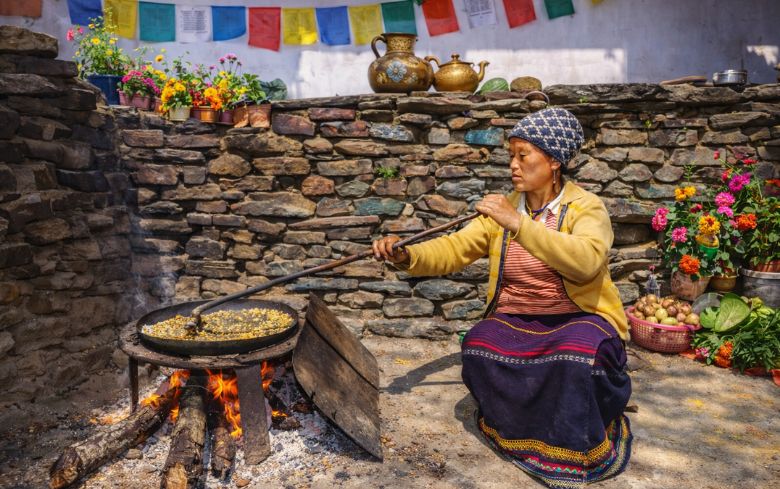 Maize flour is often used to prepare zan, a comforting porridge dish from Arunachal Pradesh.
In Arunachal Pradesh’s Monpa and Sherdukpen villages where winter sends temperatures plummeting below freezing, breakfast centres around zan—a thick porridge made from finger millet, or sometimes maize flour. The preparation appears deceptively simple: flour stirred continuously into boiling water until it forms a smooth, dense mass that holds its shape when turned out onto plates. But zan's beauty lies in how perfectly it serves high-altitude life.
Millet provides slow-releasing energy that sustains farmers and traders through long winter days. Its mild, nutty flavour pairs well with accompanying dishes of spicy meat curries and fermented cheese (churpi). Families eat it with their hands, the sticky texture and earthy taste a morning ritual as essential as prayer. This is food stripped to fundamentals: grain, water, heat, hands—ancestral and alive.
Mahindra Holidays & Resorts India Ltd. (MHRIL), a part of Leisure and Hospitality sector of the Mahindra Group, offers quality family holidays primarily through vacation ownership memberships and brings to the industry values such as reliability, trust and customer satisfaction. Started in 1996, the company's flagship brand ‘Club Mahindra’, today has over 300,000 members , who can holiday at 140+ resorts in India and abroad.